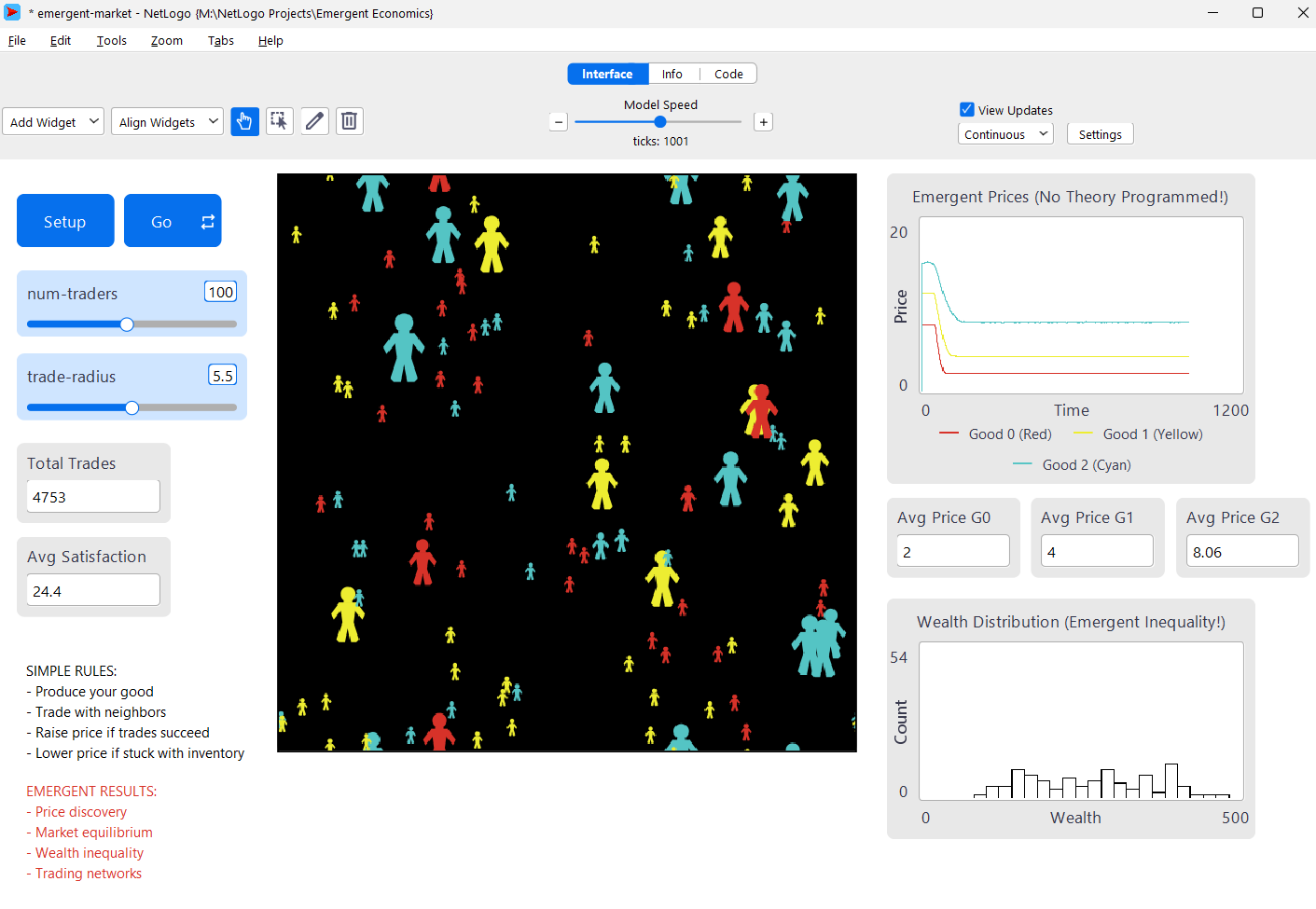
I recently built a very simple agent-based model to demonstrate that markets are an emergent phenomenon. Not because the model is novel or difficult, but to make a deeper point to a colleague: neo-classical economics has no primary ontological status. Its equations do not describe fixed, inevitable truths about reality. You do not need supply-demand curves or equilibrium mathematics to generate complex market behaviour.
In the model, market prices, scarcity premium, and wealth inequality emerge in the same way nature builds an anthill – from simple individuals following simple rules (Owner, 2026). Nothing in the simulation “knows” economics. Yet macro-level patterns arise naturally from micro-level adaptive behaviour: local interactions, bounded rationality, simple adaptive heuristics, heterogenous production/consumption, spatial constraints and inventory pressure. This mirrors the broader insight from complexity economics (Emergent Mind, 2025).
And yet economists - even agent-based modellers - often fall back into the mechanistic worldview: – the belief that a god’s-eye, perfectly knowable, perfectly describable mechanical universe exists “from its own side”. Modern physics does not support this assumption (Garisto, 2023). Reality is relational, alive, contextual, emergent - not a machine running on timeless mathematical laws .
This worldview, left unchallenged, is now causing global systemic breakdown. Jeremy Lent offers an alternative worldview (Lent, 2026).
When our large‑scale systems fail, what remains? As Otto Scharmer writes, ultimately, we have each other and our non‑human companions (Scharmer, 2022).
It is the quality of our relationships, our attention, and our intention - the way we relate to all life - that will shape the reality our grandchildren inherit.
References
Emergent Mind. (2025). Macroeconomic Agent-Based Model. Available at: https://lnkd.in/enPNkh4P (Accessed: 26 August 2026).
Garisto, D. (2023) How to Prove the Universe Is Not Locally Real, Scientific American. Available at: https://lnkd.in/ehWHJpSV (Accessed: 26 August 2026).
Lent, J. (2026) Ecocivilization: Making a World that Works for All. Melville House Publishing.
Owner, A. (2026) Agent-based models: building a market from the bottom up. Available at: https://lnkd.in/eKQ5K_ip (Accessed: 26 August 2026).
Scharmer, O. (2022) ‘Protect the Flame’, Field of the Future Blog, 14 October. Available at: https://lnkd.in/eNWUAXdg (Accessed: 26 August 2026).